Cloud & Microsoft 365
Shared hosting, VPS or dedicated server: how to choose
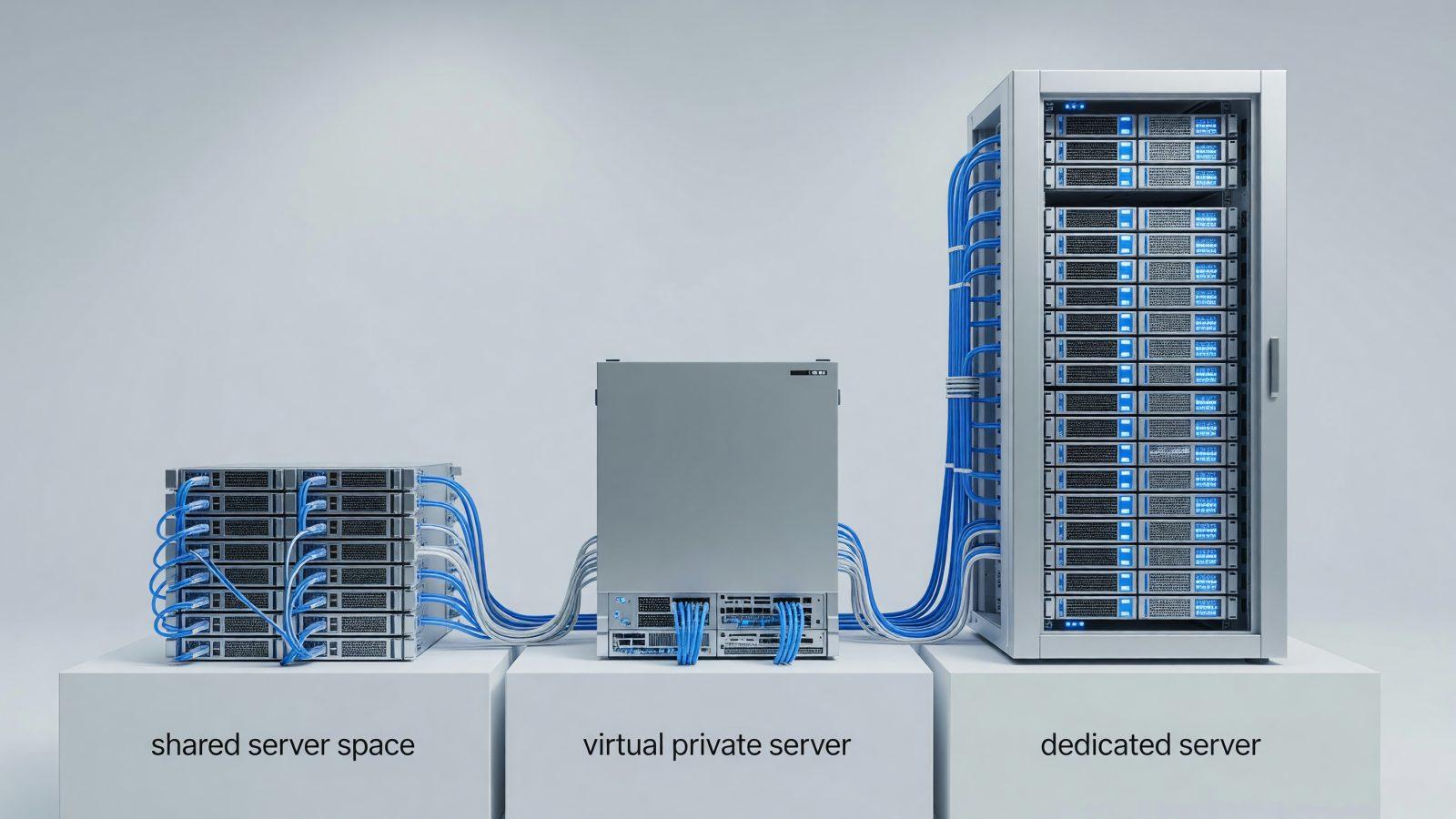
Choosing where to host your site or application is not just about price — it is about how many resources you actually get guaranteed and who is responsible when something breaks. Shared hosting, VPS and a dedicated server are three different levels of the same question: how much control and how much performance you actually need. Many companies pick a hosting plan once, at launch, and never look at it again until a visible problem shows up.
Shared hosting — what it means and who it suits
With shared hosting, your site sits on a server alongside dozens or hundreds of other sites, sharing resources — CPU, memory, bandwidth. It is the cheapest option and fits a simple presentation site with low traffic and no special requirements. The downside: if another site on the same server gets a traffic spike or a technical issue, it can slow your site down too, and you have no control over that. For a small company just starting out, it is a perfectly reasonable choice.
VPS — guaranteed resources, more control
A VPS (virtual private server) physically shares a server with other accounts, but allocates you guaranteed resources — a fixed share of CPU and memory that is yours alone. In practice you get your own isolated environment, with access to configuration options shared hosting does not allow. It is the right level for a mid-sized online store, a web application, or a site with steady traffic that has outgrown a shared plan. The price gap versus shared hosting is noticeable, and so is the gap in stability at peak hours.
Dedicated server — when you need one
A dedicated server means physical hardware exclusively for your company, with no sharing at all. It makes sense when traffic is high and steady, the application has special performance or compliance requirements, or the cost of downtime would be too high to risk on a shared environment. It comes at a higher cost, but with full control over the configuration, from the operating system down to security policies.
Rough thresholds, and signs your current hosting is holding you back
There is no universal cutoff, but a few practical signs make it clear when it is time to switch:
- The site gets noticeably slower at peak hours, even though nothing on it changed;
- An online store passes a few thousand visits a day and starts throwing errors at checkout;
- Your current hosting caps the number of databases, email accounts or storage space you can use;
- You need specific configuration (a software version, certificates, integrations) that shared hosting will not allow.
Usually a single one of these signs is enough to justify a conversation with your current provider — you do not need to wait for all of them to show up at once.
What matters beyond the price
The real difference between providers rarely shows up in the price table and almost always shows up in what happens when something goes wrong:
- Backup — automatic, at short intervals, with a real restore option, not just "we keep a copy somewhere".
- SSL certificate — included and renewed automatically, not something you have to track yourself.
- Incident response time — a clear SLA, not a "we try to respond quickly".
- Server location — matters for load speed within Romania and, sometimes, for data compliance requirements.
- Who manages it — with shared hosting and managed VPS, the provider handles updates; with an unmanaged VPS or a dedicated server, someone has to actively maintain it.
When you need a private cloud
Private cloud is the level above a dedicated server: virtualized resources, but fully isolated from other clients, with the flexibility to scale capacity up or down quickly. It makes sense for companies running several interconnected applications, with strict security or compliance requirements, or fast growth plans where a single dedicated server would quickly become insufficient. It is also worth considering when you want to remove the cost of maintaining physical hardware of your own entirely.
How to start
If you are not sure what you need, start with a conversation about web hosting or VPS, and for larger projects, about dedicated servers or private cloud. If you are switching providers, a proper migration can be done with no downtime. Contact us for a recommendation matched to your real traffic.